This essay analyses how some of the largest businesses in the world have thought about network effects, why it seems to not be future-proof and what network effects could potentially look like in the future — especially in the business models that a new decentralised internet could be the harbringer of.

Part 1: What’s broken?
Imagine a world without network effects — a world without the power that companies like Facebook (Meta), YouTube (Alphabet) or TikTok (ByteDance) have just because the data published on their platform is owned by them forever.
Today network effects are primarily driven by a platforms ability to build a loop around making a platform “sticky” for the user. Not downplaying how hard and nearly impossible this is to do but the same old story repeats itself. An initial wedge makes the platform useful and allows users to create something they are proud of and want to share with their friends. This attracts more users to join, more features are built, even more users join the social graph takes off and the platform increases in utility and grows. What follows is always multiple classes of users are formed — some are influencers, some are influenced and some are watching from the sides. The biggest winner is the platform and while they share some part of the value created, the platform becomes a powerful force.
So powerful in fact, that it could potentially topple a government, swing an election, lead to loss of life and create various other loops of unthought-through consequences.
As an average user, you love it until you don’t. In reality, Facebook, Google, Twitter (and other big winners of what this definition of network effects entails) started out with a capitalist-but-not-evil vision (I feel Zuck gets a lot more criticism than he deserves) and truly made some pathbreaking innovations. They’ve been instrumental in shaping the modern world and much of the criticism for these unwanted consequences should lie with the unthinking-majority perpetrating them but for now let’s focus on the technology and not on the ethics of it all (though Web3 couples tech and ethics more tightly than before).
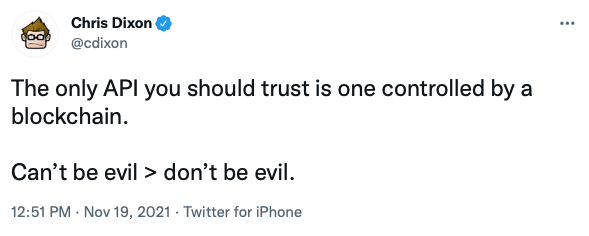 https://twitter.com/cdixon/status/1461723922336915459
With this centralisation of power, many actions are almost impossible to contain. Prolific Web3 evangelist and investor Chris Dixon seems to be right and Google (the creators of the unofficial “don’t be evil” motto) seem to have realized this when they quietly removed these words from their code of conduct in 2018.
Whenever we have a closed boardroom with human brains making critical decisions, the judgement will become cloudy, partial and subjective depending on how incentives are aligned. This is outlined in two great but slightly contrasting examples:
Firstly, Twitter’s decision to censor a New York Post story that implicated Joe Biden as corrupt. The whole episode has been described by Mike Solana very well in his Substack article on Twitter’s censorship but to in short, Twitter chose sides, unilaterally decided this story was unfounded and needs to be contained and went ahead and took measures preventing the spread of this story (to date the story hasn’t proved to be inaccurate).
What’s even more interesting is Jack Dorsey’s reaction that showed that he was possibly at loggerheads with the decision to implement this censorship.
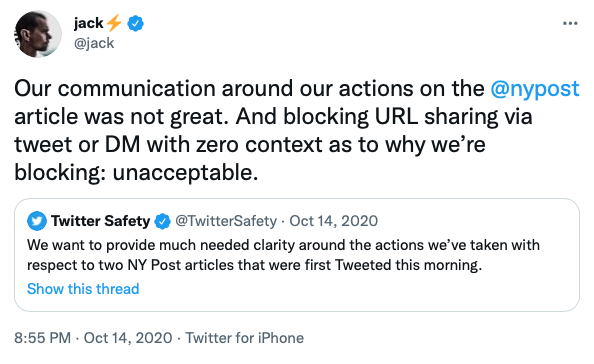 https://twitter.com/jack/status/1316528193621327876?s=20
He’s since moved on from Twitter while they continue investing to build a decentralised social media protocol with BlueSky that Twitter itself wants to be the first customer of.
Secondly, is a much older example from 2015 where one of the first moves Alexis Ohanian put into motion (as the former co-founder and CEO of the backpage of the internet returned as Chairman) was to ban non-consensual nudes, a decision which the previous CEO opposed in the spirit of free-speech that Reddit had always been an advocate of. It’s debatable how effective the move has been but showed bold-decision making in action.
How is this related to Network Effects?
The above two examples, show that companies will make decisions based not just on data but on opinions (and the belief that they have too wield the weapon of righteousness). But at the end of the day, these decisions are taken to ensure minimal impact on the flywheel of network effects keeps spinning, shareholders make money and there is growth.
In the recent past Big-tech has exhibited more liberal-leaning tendencies. A few handpicked examples are Apple, Google and Amazon collectively deciding to ban Parler (an app that allowed people to organize their own social network and the network on which the Capitol Hill attack of January 2021 was allegedly planned) or Twitter deciding to side with the left (as they de-platformed Trump and stopped the story about Biden from spreading).
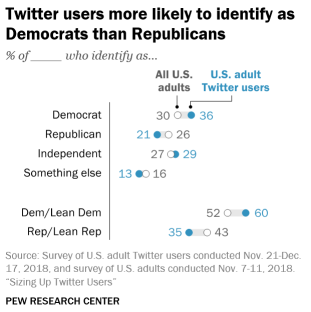 https://www.pewresearch.org/internet/2019/04/24/sizing-up-twitter-users/
The way their incentives are structured, they tend to take decisions that least impact their incentives while asserting some amount of moral high ground.
The bottom line is personal opinions will vary, opposition will always exist and this ends up perpetuating more polarisation and no matter which way a company decides to go — they would have shot themselves in the foot. In the old days, this what led to the formation of countries, political ideologies and niche groups.
We were always moving one step towards decentralisation — and asymmetry in the way social networks in a web2 world are architectured merely accelerated it. But before deciding which version of decentralisation should win, let’s list out what’s broken.
Centralised Governance
Closed and controlled platforms are realising that putting themselves as the central authority of any kind of decision making is dangerous. Reddit was probably the first platform at scale to decentralise some power and empower communities driven by moderators, but that has led to similar problems but at a smaller scale.
In the past, centralised governance was a big strategic advantage and offered tremendous leverage (that turned into an ad revenue pretty quickly). Today, they know they can’t keep winning like this.
This structure of governance being centralised with a platform will not work, decision making will need to be decentralised — and calling business leaders to congressional hearings, police summons or a regulator will just change which centralised authority will wield the power, not solve the problem (and between politicians, retired public servants and tech CEOs I would still choose tech CEOs).
Overall Incentive Structures
Incentive alignment in Web 2.0 has missed the mark completely. The platforms which created many big names in multiple genres made using video (YouTube), shorts (TikTok), lifestyle (Instagram), music (Spotify) delivered fame to some and financial independence to even fewer.
“For the Internet to thrive, content providers must be paid for their work. The long-term prospects are good, but I expect a lot of disappointment in the short-term as content companies struggle to make money through advertising or subscriptions. It isn’t working yet, and it may not for some time.”Bill Gates, 1996
Bill Gates — a pioneer of what the modern internet is today, knew of this back in 1996 (Li Jin wrote a great piece about this recently).
In the same article, Li says — “If the pre-internet/web1 era favored publishers, and the web2 era favored the platforms, the next generation of innovations — collectively known as web3 — is all about tilting the scales of power and ownership back toward creators and users.”
The reality is Web 2.0 platforms have traditionally delivered just enough value to be in a position to dominate and until a few years back, only a few looked at creation as a viable career option. Well, things have changed and platforms too will need to.
This has lead to Imbalanced Creator vs Platform Economics
Web2 companies are not the enemy. Back in the day, the utility a platform like Facebook offered was delightful. That being said, even though the dependence of these networks on user-generated content was pretty clear from the start, the currency in which they were paid was clout and turning clout into money was up to the user creating the content.
This model created a few success stories in the past but most creators could never get enough to make the pivot full-time but it’s clear now how disparate the economics here are and many indie-platforms as well as larger more established ones have proven that a better model is possible.
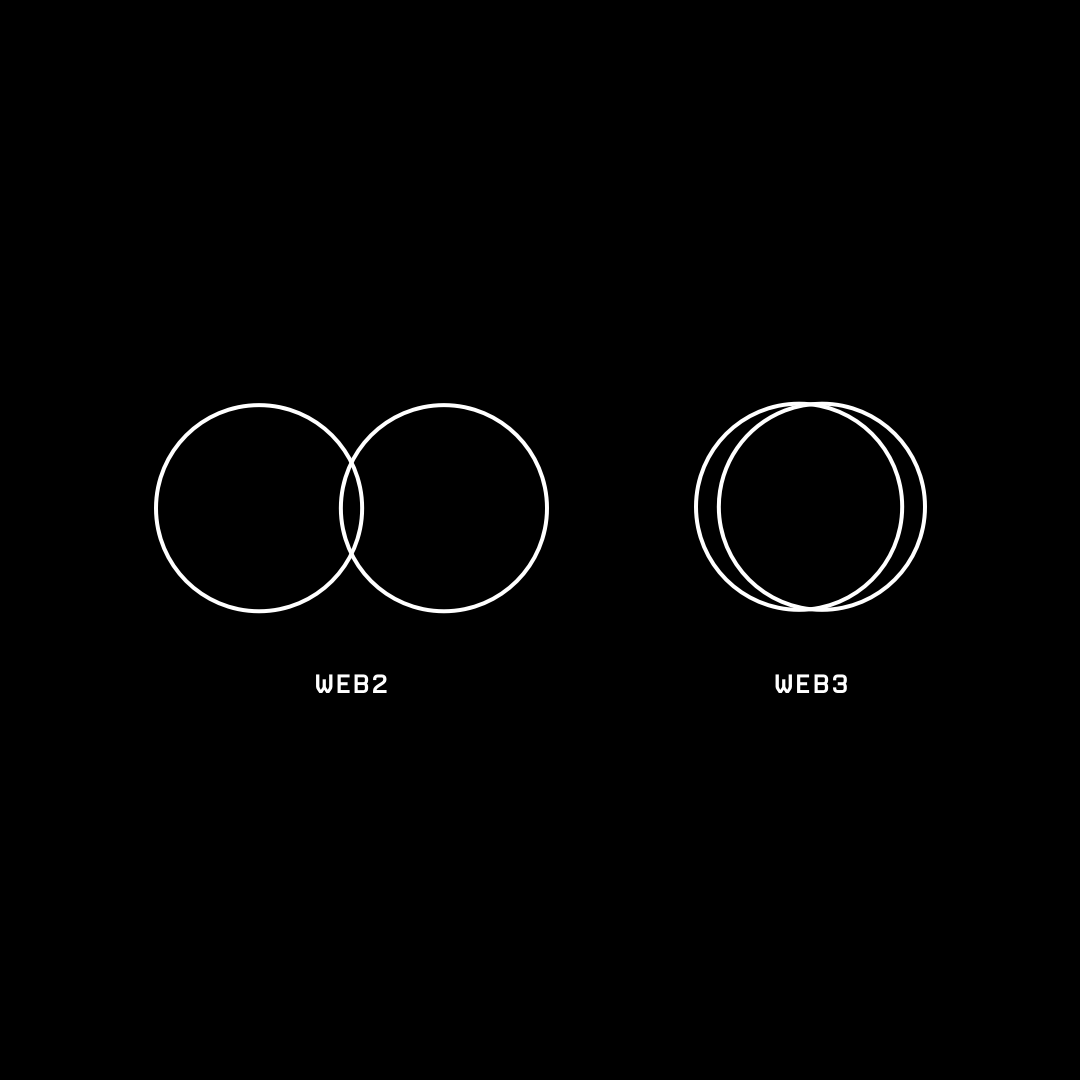 https://twitter.com/jackbutcher/status/1472029166782533636?s=20
Part 2: What could Web3 fix?
Web3 is not a silver bullet and Bitcoin, Ethereum, DeSo or Solana (or any of the others) are not going to magically solve the problems caused by companies dependent on a network-effects based on users finding value. If the past is any indicator of the future, technology evolution enables progress and at the same time unintended consequences surface.
But they offer a better way.
The first thing that Web3 fixes is that it brings some order to how to contain the amount of power Web2 platforms have had (in some ways straying from the path the original internet showed):
**Web1 —**The first version of the modern internet was built by engineers and academicians and the users as well were mostly engineers and academicians.
**Web2 —**Took advantage of the capability and possibilities the internet presented and the builders were Bigtech corporations (engineers, operators and investors) and the users were pretty much everyone since over time, it has become easy to use for even someone who is not very internet savvy.
Web3 — This iteration of the internet is still early and engineers and true believers (whether of the technology or just maximalists) have been leading the way but recently, mainstream engineers, operators and investors have been arriving in hordes. It is essentially the capabilities of the modern internet but with decentralised ownership and governance, a more palatable distribution of power.
The growth of Web3 does not mean Web2 is over. There are many people in the world who have never even experienced the power of a connected world but this is probably an example of the uneven distribution of the future. Web2 will continue to grow, improve and solve key challenges while the builders of Web3 figure things out and build the future.
What could network effects look like for a social platform built when (and if) the internet is completely decentralised?
Sticking to familiar terminology — assume TikTok, YouTube and Substack are all creator-focussed platforms built on a blockchain optimised for social media use cases (like DeSo for example). What happens then?
- A talented musician creates an account on TikTok and launches a token. They make an initial investment, and launch a token that has a minimum value based on the creator’s buy-in.
- Over time, they create short video clips and attract a large number of fans as they grow. The value of their token increases (read the DeSo whitepaper to go into details). Some fans just follow their content while others really like this creator and decide to back them by buying their tokens. Things are looking good.
- The creator’s fame increases to millions of fans and early fans who invested in the creator are also rewarded as they make better returns on the tokens they bought. (In the current world, this appreciation benefits only the network and the creator, not the fan).
- They now want to diversify into long-format videos. Since all user accounts are created on the blockchain (DeSo in this case) all user accounts are decentralised. So if they have 1 million fans on TikTok, on Day 1 of creating a YouTube account — they have 1 million subscribers on YouTube, all their TikTok videos already exist as YouTube Shorts and they can just start making longer format videos on YouTube (which is the value that YouTube’s technology brings).
- They want to write a newsletter directly delivered to their fans. Same story, create a Substack account and all users on the blockchain who have verified their email accounts will already be there as subscribers. No need to start from 0 every time you join a new platform to explore a new format of content.
In this decentralised system, clout and data are completely decentralised. A user’s content, followers and reputation are decentralised will be transferrable, no more gatekeepers. A platform wins only based on true innovation. There will still be big winners and smaller niche winners but absolute control due to having ownership of large amounts of user data will not exist anymore and a more level playing field will exist.
The creators of these platforms will still make money but will probably have to work harder and get a smaller slice of the cake.
I’m very hopeful about the possibilities that Web3 enables and the particular impact it can have on creative people who have been adding value to large corporations without getting what they truly deserve.
Also hopeful that this is an opportunity to rewrite the rules of the game and the internet (and financial institutions) moves away from rewarding platforms to become superpowers based on user acquisition based network effects, average technology, and low innovation but rather platforms that have great tech and network effects driven by innovation and niche interest.
If you’re unsure of some of the terms used in this article, a good pre-read could be Chris Dixon’s piece —Why Web3 Matters.
This is the first time I am publishing something that I feel strongly about so if you like it, think it’s trash or are somewhere in between— drop a comment orlet me knowhere.
Originally published on Medium. You can view the original article on Medium.