Shopify claim to make commerce better for everyone. Despite the fact that $SHOP is trading 75% below where they were exactly a year ago, I (and nearly 6 million stores using the Shopify platform) believe that they deliver on their promise.
Since their origin in 2006 as a tool that simply allowed you to launch an online store, they’ve come a long way. Just how much is outlined in this diagram below where I have divided Ecommerce as I know it into 4 parts:
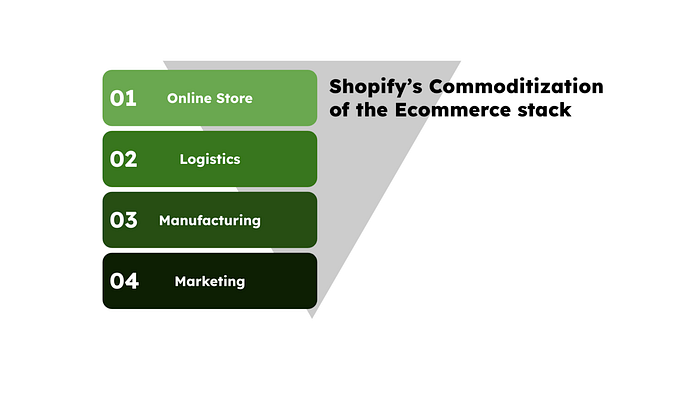 How Shopify seeks to commoditize the ecommerce stack
Building a successful online business (DTC, D2C, CPG — whatever the cool kids are calling it these days) has the following four components, all of which can completely or partially be done by Shopify today:
- Launching an online store— this is something Shopify has been doing for the longest time, they successfully commoditised it and now competes with global players like Wix, Squarespace and local players like Vtex, Nuvemshop, Dukaan, Baozun.
- Logistics for order fulfillment — Shopify’s (very public) foray into building it’s own fulfillment network (SFN or Shopify Fulfillment Network launched in 2019) has been very successful, included a $2.1B acquisition (Deliverr) and is one of two subjects which has been getting a lot of spotlight in their earnings calls. Safe to say you can just launch a store and if you’re in a serviceable area, Shopify will deliver the order for you — well on their way to commoditizing this as a part of their full stack offering.
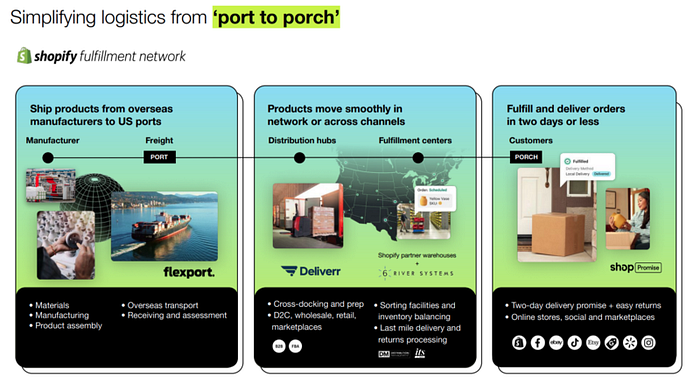 Shopify want to capture a bigger piece of the value they create
- On Demand Manufacturing — In case you are launching a store selling digital goods, this is not a problem but for physical goods — Shopify has taken the first steps towards building their own “print-on-demand” service. Currently existing only for a few categories like T-Shirts, Mugs, Totes, there will be a time in the not-so-distant future where either through partnerships or acquisitions, Shopify will further the commoditisation they can deliver here — which will make it easier for a lot of talented/untalented people to take their first steps.
 Shopify seems to have begun offering on-demand manufacturing as a service
- Marketing— So far so good but this, I believe, is where Shopify’s efforts to commoditise E-commerce could hit a roadblock. The second subject which is mentioned innumerable times while delivering their quarterly earnings is the “Creator Economy”. This is also where one of the biggest opportunities in the future of Ecommerce could lie.
Shopify has created a huge industry — and many other local companies are competing in the well-deserved niches they are creating but the biggest threat to this industry is from Amazon.
“Amazon is trying to build an empire, and Shopify is trying to arm the rebels,” — Tobi Lütke (2021)
Amazon vs Shopify is not a fair competition. As Tobi Lütke said, Amazon is more focused on building breadth and becoming the everything store while Shopify is more focused on arming the rebels and the misfits but it wasn’t always so and may not always be.
Once upon a time in the early 2010s, Amazon had it’s own Shopify competitor called Amazon Webstore — which shut down in 2015 and Amazon actually encouraged their 80,000 existing customers (including brands like Lacoste) to move to Shopify. They made a u-turn a few years later when they acquired an Australian Shopify alternative but then shut that down as well earlier this year. They are now focusing on brands being able to create a storefront within the Amazon website.
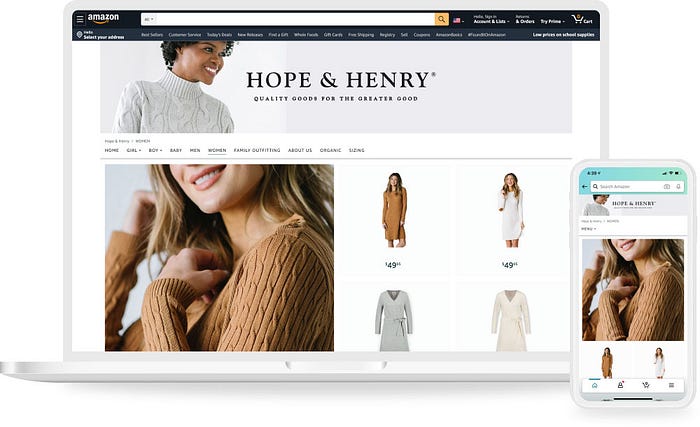 Storefrontfor brands within the Amazon website
Today, many E-commerce (DTC, D2C, CPG) business owners know the strong incentives of building a brand and ensuring sales are driven through websites they own but rely on Amazon, Flipkart, Mercado Livre (or the local alternative) for true distribution and scale, often sacrificing independence and margins for volume.
Influencers and the larger creator economy could hold the key to making this an even contest. While proprietary manufacturing will continue to retain a strategic advantage, brands realize that the hardest challenge is to compete with the distribution-power Amazon (and equivalents) have. This is a huge problem that brands face today (and honestly limits DTC realizing it’s true potential) and while there are interesting solutions like the ONDC program by the Quality Council of India (and others), disrupting the Amazon monopoly is not an easy task.
The other major challenge is how creators make money online and start thinking of it as a full-time profession. Since “Knowledge Creators” are a relatively small segment of the overall creator economy (less than 10%), creating cohort-based courses, ebooks and masterclasses is reserved for a small portion of the creator class. Many lifestyle creators focus primarily on luxury, beauty and travel which makes it hard to get a loyal audience that helps them skip to one of the more lucrative models of monetizing their audience.
Influencer marketing and affiliate revenue continue to be the most accessible way for these creators to make money and Shopify Collabs (even their link-in-bio tool, Shopify Linkpop) is built on the same principal.
With a vision to the far-out future, I truly believe the union between the creator economy and ecommerce will keep getting stronger and stronger. A category of creators have already started to see this and launch ecommerce brands of their own. But what are some other business models which could be built to leverage this movement? That’s the question I am asking myself today.
Originally published on Medium. You can view the original article on Medium.